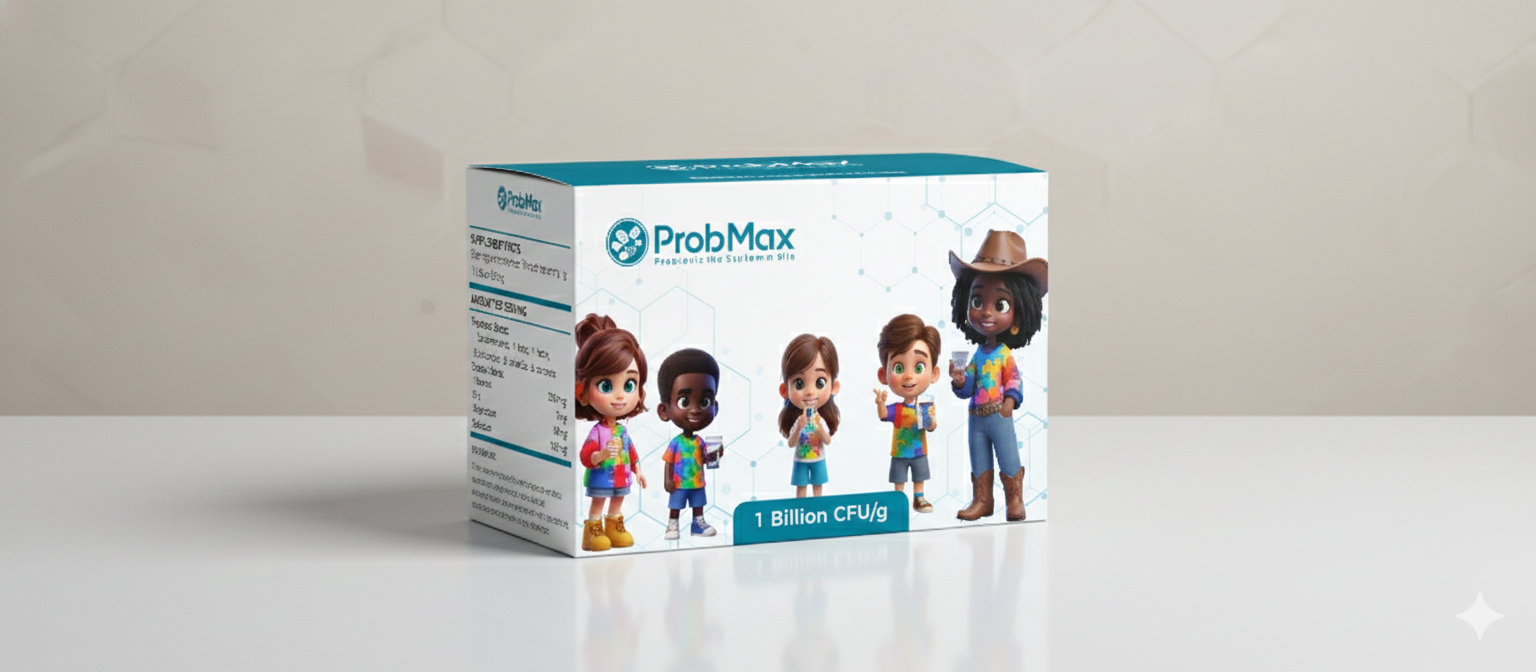
GOn1 Biotech, a leading international research center listed on the American “Good Clinical Practice Networking” platform, conducted one of the world’s largest studies using a specific probiotic mix, involving children with Autism Spectrum Disorder (ASD). This research was carried out over several days in a randomized, placebo-controlled study focusing on the effects of ProbMax, an innovative probiotic supplement enriched with vitamins. The results were promising, with significant improvements observed in adaptive behaviors, cognitive functions, and gastrointestinal health in the children treated with ProbMax.
These findings align with the growing scientific evidence supporting the connection between the gut-brain axis and neurological conditions. For example, the systematic review by Wenxi Liu et al. (2023), published in the journal Nutrients, revealed that probiotic supplementation can have positive effects on behavioral and gastrointestinal symptoms in children with ASD. Although the overall effect found in the meta-analysis was considered moderate, the authors emphasized the need for more well-designed clinical trials to consistently verify the efficacy of probiotics (MDPI).
Additionally, the study by Santocchi et al. (2020), published in Frontiers in Psychiatry, highlighted how probiotic supplementation can improve symptoms such as socialization and quality of life in children with ASD, further supporting the importance of gut microbiota modulation (Nature).
These studies, reinforce the therapeutic potential of ProbMax, which combines exclusive probiotics with nanotechnology to offer a disruptive, safe, and effective solution for the treatment of ASD.
With this data, ProbMax positions itself as an innovative alternative, leveraging cutting-edge science to improve the quality of life for autistic children and their families.
In a recent study involving more than 200 children, aged 3 to 11 years, across support levels 1, 2, and 3, researchers observed significant changes after 45 days of probiotic use. However, the best results were achieved with 90 days of use, with improvements observed in cognitive, motor, neuropsychopedagogical, and gastrointestinal areas.Most parents reported noticing subtle improvements as early as the second week of consistent use.
During one year of continuous use, no significant side effects were reported, and more than 92% of volunteers showed significant improvements in one or more evaluated areas.


Noah has made a lot of progress. His concentration has improved, his irritability has decreased, he’s more cooperative, he’s talking, and he’s having bowel movements.

My prince is eating by himself, this is a dream.

My Victor, a significant improvement in bowel function and memory. He was having a lot of difficulty with math and now he does the calculations and is learning the violin easily. Gratitude for participating in the research and to GOn1 for our children.